
Christless Conservatism
A guest post by Jacob Tanner arguing that "Christless conservatism looks pretty on the outside before it crumbles to pieces because it failed to build on a solid foundation."


Jacob Tanner is the pastor of Christ Keystone Church. He has written several books, and is a fellow of Puritan Thought with the Ezra Institute. He lives in Pennsylvania with his wife and sons.
From the beginning of man’s creation, he has been tasked with the conservation of what God has entrusted to him. For example, in Genesis 2:15, God’s charge to Adam is to both work the ground and to keep it. Keeping, in this sense, relates to the idea of protecting, preserving, and conserving the Garden. To do this, God gives Adam the commandment forbidding him and his posterity from eating of the Tree of the Knowledge of Good and Evil (Gen. 2:17). The implication is profound: If Adam will work the earth and take dominion of it for God’s glory, and if he will cultivate a meaningful culture, then God’s Law must be kept. Thus, a meaningful tradition is established, intended to be preserved throughout the generations: All trees may be eaten from, but not the Tree of the Knowledge of Good and Evil.
Of course, when the Serpent enters the garden to tempt Eve, Adam has already failed in his conservation effort. While he was to protect the Garden of Eden and his wife, and while he should have crushed the Serpent’s head the moment he slithered into the Garden, the Serpent is instead permitted to speak. And, as the Serpent speaks, he twists God’s Law, sows doubt in the woman, and convinces her to liberate herself from the tradition she was instructed in.
Human history is replete with examples of these two paths: Liberalism versus conservatism. While liberalism seeks to “liberate” society from the traditions of the past in an ever onward “march of progress,” conservatism seeks to maintain and preserve past traditions and philosophies, recognizing that the march towards “progress” (a cultivated society) is impossible without conserving some of the wisdom from the past.
While many have written on the battle between liberalism and conservatism, I believe that there is a different—perhaps even more important—battle to be waged, and that is the battle between Christian conservatism and what I will refer to as Christless conservatism. The former is predicated upon the knowledge that Christ is the Sovereign King of the cosmos and all people, everywhere, must bow the knee before Him, submitting to His will as revealed in His Word. The latter is actually a type of liberalism, as it stands upon the shoulders of Christian laws, ethics, and philosophy, while simultaneously attempting to liberate itself from obedience to the Kingship of Christ.
Christless conservatism will, inevitably, descend into chaos. Christian conservatism, on the other hand, will not only meaningfully preserve the past, but will result in the final fulfilment of both the Dominion Mandate (Gen. 1:28) and the Great Commission (Matt. 28:18-20), through which the world will effectively be made a footstool beneath the feet of Christ before His return (1 Cor. 15:24-26).
Conservative Values Without Christ?
In Jeremiah 6:16, God calls out to His covenant people:
Stand by the roads, and look,
and ask for the ancient paths,
where the good way is; and walk in it,
and find rest for your souls.
God’s call for the nation of Israel was for them to practice a form of conservatism. Rather than rejecting God and His Word, they were instead to seek Him out once more, returning to the paths their ancestors once walked. This was not a call for the nation to stagnate and pause in time, but to not take another single step forward until they were sure they were standing once more upon the ancient paths their covenant ancestors had walked.
The people respond, however, that they will not do so. “But they said, ‘We will not walk in it’” (Jer. 6:16). And, thus, their fate was sealed: In Jeremiah’s own day, he would witness the fall of his beloved Jerusalem to an invading Babylonian army.
The Prophet Jeremiah knew something about a society that attempts to maintain a conservative ideal while rejecting Christ. The Jews of his day maintained their religious identity—at least externally, to some degree—as followers of Yahweh. Inwardly (and privately) they lived as the pagans surrounding them. They were, as Jesus would later describe, white-washed tombs: They bore the external markings of traditional holiness (at least as far as other cultures would have witnessed), but inwardly they were rotting (Matt. 23:27).
There is, perhaps, no better image for Christless conservatism. Without Jesus Christ and His Word as the foundational center, grounding our conservative beliefs, we typically pick to conserve only those values that seem to be most beneficial to ourselves personally. Without something like the Ten Commandments guiding us ethically, we are left to our sinful machinations to haphazardly select laws that seem best to us; laws that, without fail, aim to benefit us with little regard for the rest of society.
Christian conservatism recognizes that the reason for which God created humanity was to “Glorify God and enjoy Him forever” (WSC Q&A 1), and thus the only way to live a meaningful and fulfilling life is in the pursuit of this goal. This fundamentally requires the Christian to know the Word of God so that he can both submit to it and instruct others to do the same (Matt. 28:19).
Remove Christ from the conservative system, and what does it become? A means of justifying and preserving one’s own traditions with little regard for right or wrong. It may give off the appearance of holiness, but the inward nature of it is that it’s a rotting corpse, without Christ. And, if the center is rotten, the beautiful image it projects will eventually disintegrate.
At its best, Christless conservatism is simply therapeutic moral deism. It may make the advocate feel righteous and holy and may even convince him into believing that he holds to a higher moral ground than his opponents. In one sense, he does. He’s like a squatter that has taken shelter inside a house that another has built. But he’s also removed all the structural integrity of the house by removing Christ from the equation, and all that external beauty will collapse without anything to hold it up.
Eventually, Christless conservatism must devolve even further, still. The possibilities for it at this juncture are two-fold: 1. Liberalism; or, 2. Ethnocentrism.
In the first instance, Christless conservatism begins to shape shift further until it’s ethical claims become entirely subjective. In just a short time, Christless conservatism will look little different than modern liberalism, as it will be forced to confess either a morality that is entirely self-constructed, or at least a projection of society. In an attempt to liberate itself from any sort of obedience to God, it will embrace an autonomous self-centeredness, wherein ethical claims are made and kept only to benefit the one making the claims. This is where conservatism begins to embrace things like gay marriage, abortion on demand, and gender fluidity.
In the second instance, Christless conservatism becomes ethnocentric; that is to say, it becomes focused on a sort of nationalism that favors ethnic and racial heritage above all else. In an attempt to conserve the past, it begins to hate those whose heritage differs from its own. Without the supernatural elements of Scripture to ground it, it is forced to seek commonalities elsewhere to preserve the past, and those commonalities become almost entirely physical in their appearance. This is often how groups like the Ku Klux Klan and Neo-Nazis find their formations.The vibe shift shifted them right along with it, and to preserve popularity, they were willing to compromise biblical truth. (cont. below)
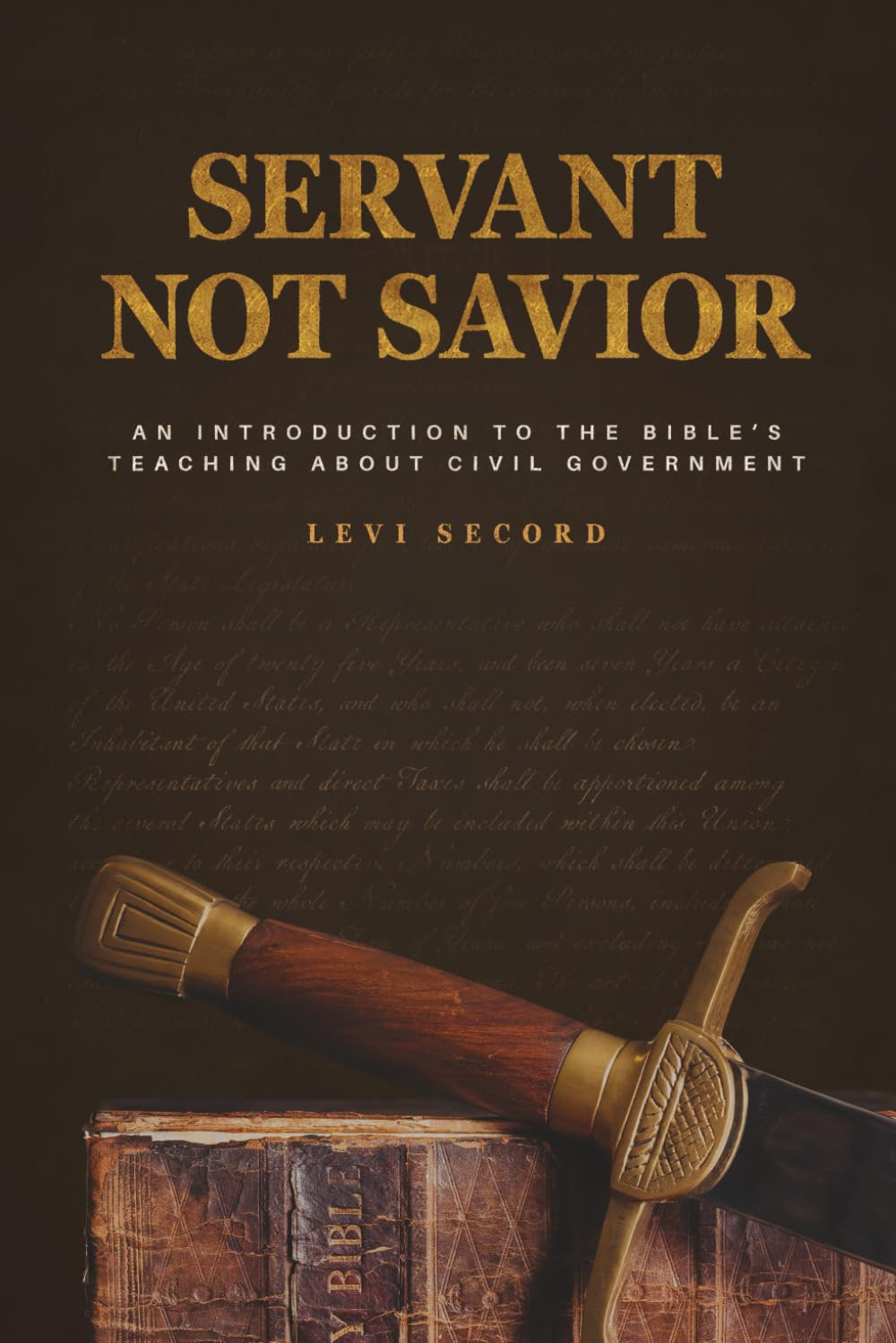
God’s design is for the state to be a servant, not our savior. Sadly, as we’ve abandoned God’s instructions, people across the political spectrum treat the state as a potential savior. Today is the day of big government as people consistently cry out to the state for salvation. Politicians take on Messiah-like personas, yet time and again they fail to deliver on their promises. Both history and Scripture teach us that the state makes a terrible savior. Christians, of all people, must recognize the frightful implications of turning the state into a savior. To counteract this trend, the church needs a robust political theology.
This book by pastor-theologian Levi Second addresses every major issue touching on a biblical theology of the state and politics. Likely no book of this size has ever been written which addresses so many vital issues related to politics in the Christian worldview and addresses them with greater biblical fidelity.
This book is a distinctively biblical education in political theology.
Get the book here, both hard and digital copies.
(cont.)
The Old Paths of Christian Conservatism
When God spoke to the Israelites through the prophet Jeremiah, He spoke a perennial commandment that we are in desperate need of hearing and obeying today:
Stand by the roads, and look,
and ask for the ancient paths,
where the good way is; and walk in it,
and find rest for your souls.
We need to cry out for the ancient paths, which means we must first bow the knee to Christ and walk the path of the Christian before we can begin to meaningfully conserve anything worth keeping. Only as Christians can we conserve the philosophical, political, ethical, and religious past.
A shared history, moral imperatives, and political systems are not enough for conservatism to flourish, let alone survive. Roger Scruton made this distinction in his work Fools, Frauds and Firebrands, when he recognized that politics alone is an insufficient tool for conservation. Something else—something spiritual—is needed: “We need spiritual authority, the ability to make sacrifices, and the refusal to be degraded into the machines désirantes of Deleuze and Guattari. This changed way of life does not come from politics. It comes from religion and culture, and in particular from the God-imbued culture…”[1]
The “machines désirantes” is an idea that all Christless people must embrace, for it states that a person is little more than a machine who must produce some sort of result or another. The important task for society is to program the machine to desire to produce the result most beneficial for all. Not only is this a robotic philosophy of slavery, but it is also futile. Men cannot be reprogrammed like robots to desire something other than sin. The only salvation a man can experience is the spiritual heart change that Christ alone offers the sinner, through faith in His death, burial, and resurrection.
A Plea to Return to Christian Conservativism
There are two paths ahead: 1. Burn everything in Western society down to try and march ahead to the future, which will lead to immorality and ultimately failure. 2. Conserve the virtuous principles of Christendom’s past and march forward, not upon new or even updated principles, but upon the firm foundation of God’s Word and Law. Russel Kirk pointed out that, “Men cannot improve a society by setting fire to it: they must seek out its old virtues, and bring them back into the light.”[2]
Christianity alone has the power to lead one to virtues. C.S. Lewis recognized this in his famous essay The Abolition of Man. In this essay, while living in a generally “conservative” society, Lewis lamented how society had still rejected the virtues of Christianity. In doing so, a generation of men “without chests” had been created. Lewis wrote that this is a “tragi-comedy” wherein “we clamour for those very qualities we are rendering impossible.” He goes on to add, “We make men without chests and expect of them virtue and enterprise. We laugh at honour and are shocked to find traitors in our midst. We castrate and bid the geldings be fruitful.”[3] Again, this is the fruit of Christless conservatism.
For Lewis, the problem of society was not a rejection of conservative values, but a rejection of Christian virtues, and the rejection of the virtues could be traced back to a rejection of biblical morality. Lewis saw man as being tripartite in his being, being ruled by the head as the seat of the intellect, the stomach as the seat of emotion, and the chest as the seat of virtue. But men without chests cannot govern their base emotional appetite with mere intellect alone. In fact, without a virtuous chest, a man will use his intellect to become a slave of his passions. This is Christless conservatism: virtueless men attempting to govern by their mere intellect, and being consumed by their passions.
Genuine conservatism depends upon Christian virtues for its good. It cannot survive without them. This is why Christians ought to ultimately pause when they hear someone advocating for conservative values without actually being a Christian. It’s also why a Christian ought to pause when someone makes conservative ethical claims without grounding them in the Bible. And, if someone advocates for conservative economic, political, or philosophical aims without Christ, we ought to run the other way. This is not the ancient path we have been called to travel. Without the Bible, the system fails.
The truth is this: Christianity grounds conservatism with both a moral compass (God’s Laws) and directives for future humanitarian progress (God’s Word and revelations). Whereas liberalism attempts the march of progress without Christ and ends up in a ditch (Matt. 15:14), and whereas Christless conservatism looks pretty on the outside before it crumbles to pieces because it failed to build on a solid foundation (Matt. 7:24-27), Christian conservatism stands upon the shoulders of past Christians, sets its eyes on Christ, and seeks His will in all things (Heb. 12:1-2).
Register Today for This Once-In-A- Lifetime Event

More great stuff
The Center for Cultural Leadership site is here.
My Amazon author page (print and digital) is here.
My I-Tunes sermons, lectures and podcasts are here.
You can find my sermons and lectures at my YouTube channel.
Sign up to get my blog updates here.
Here’s my Twitter feed.
If you want to get the free exclusive hard copy publication Christian Culture, please send me a Facebook private message.
The CCL phone number is 831-420-7230.
The mailing address is:
Center for Cultural Leadership
P. O. Box 100
Coulterville, CA 95311
[1] Roger Scrutuon, Fools, Frauds and Firebrands: Thinkers of the New Left (London: Bloomsbury Publishing, 2015), 280.
[2] Russel Kirk, The Conservative Mind 7th ed. (Washington: Gateway Editions, 2016), 270.
[3] C.S. Lewis, The Abolition of Man (New York: HarperOne, 2001), 26.